

OUR SERVICE MODEL
AIThalassemia delivers an end-to-end solution for identifying thalassemia carriers and supporting patients. Below we outline our process and how we collaborate with healthcare providers
DATA ACQUISITION AND INTEGRATION
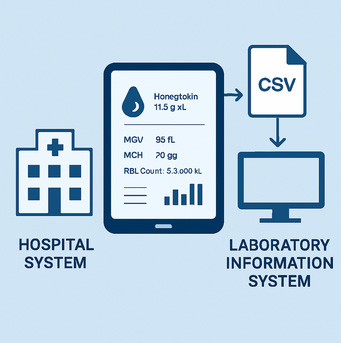
We connect directly to your Laboratory Information System or Electronic Medical Record to receive complete blood count (CBC) results, including hemoglobin, MCV, MCH, RBC count and RDW. Alternatively, you can batch-upload CSV files. These values are sufficient to assess risk because carriers often exhibit low MCV/MCH with elevated RBC counts.
AI ANALYSIS AND RISK STRATIFICATION
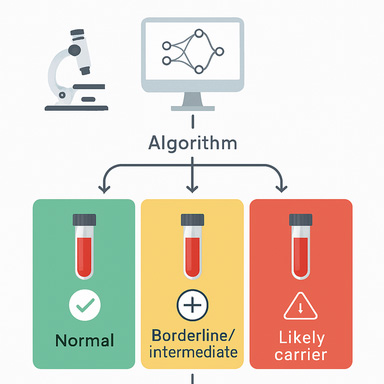
Our algorithm applies red-cell-index cut-offs (MCV < 80 fL or MCH < 27 pg) and machine-learning models to calculate a risk score for each sample. Results are categorised into:
- Normal: All indices within reference ranges; no evidence of carrier state.
- Borderline / Intermediate: Slightly low MCV/MCH or borderline RBC counts. We recommend repeat testing or iron studies to exclude iron deficiency before pursuing confirmatory testing.
- Likely carrier: MCV < 80 fL and/or MCH < 27 pg with high RBC count. These samples are flagged for confirmatory testing by HPLC or capillary electrophoresis, and genetic counselling is advised.
Report Generation
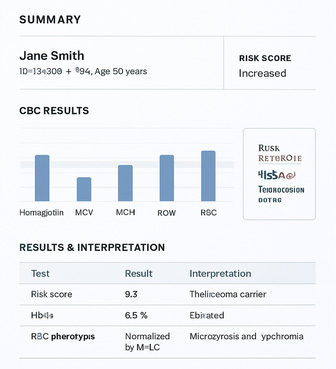
For each sample, AIThalassemia produces a clear, printable report summarising CBC values,
calculated indices and recommendations. Reports can be exported in PDF format and
automatically stored in the patient’s record. See our sample report for details.
Education and Counselling
We provide educational materials that explain thalassemia, inheritance patterns and reproductive options.
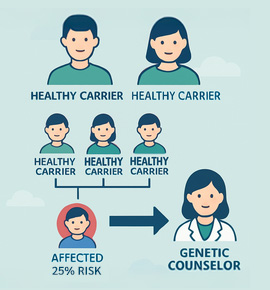
Patients learn that carriers are healthy but can pass the gene to their children, and that when both parents
are carriers there is a 25 % risk of an affected child. We also offer referral pathways to licensed genetic
counsellors.
Analytics and Population Insights
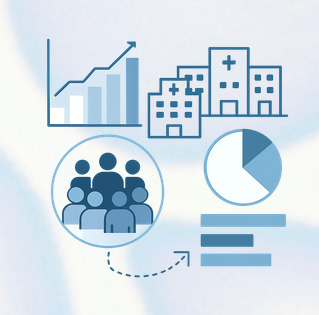
De‑identified, aggregated data allow hospitals to monitor carrier prevalence by region,
identify high‑risk groups and evaluate program impact over time. These insights
support public‑health policies and resource allocation.

Training and Support
Our team provides onboarding sessions for laboratory and clinical staff,
covering result interpretation, patient counselling and workflow integration.
We deliver ongoing technical support and regular updates as new research
emerges.
WHY HOSPITALS CHOOSE AITHALASSEMIA
- Improved quality of care: Early carrier detection allows families to make informed reproductive decisions. Pregnant women in many countries are routinely offered thalassemia screening; integrating AIThalassemia into prenatal clinics streamlines this process.
- Flexibility: Our platform scales from small clinics to national programs and adapts to local reference ranges. It operates in multiple languages and is accessible via web and mobile devices.
- Research and innovation: Participation in AIThalassemia enables hospitals to contribute data (with consent) to ongoing research, improving algorithms and informing future therapies such as gene therapy for beta thalassemia.
READY TO GET STARTED?
AIThalassemia simplifies thalassemia carrier screening and provides actionable insights for clinicians. Contact us to discuss integration options, receive a demo or start a pilot programme.